
Cross-Dock It or Store It? How to Make the Right Decision When Freight Arrives
The right choice depends on the freight’s next destination, how soon it needs to move, and whether it requires any work before departure.
The truck has arrived, but the freight’s next move is not as obvious as it should be.
Some pallets are already assigned to customer orders. Others may not be needed for several weeks. A few need new labels, and the outbound carrier is scheduled for tomorrow morning.
Sending everything into storage creates extra handling, but attempting to cross-dock the entire load could create confusion at the shipping door.
The right choice depends on the freight’s next destination, how soon it needs to move, and whether it requires any work before departure.
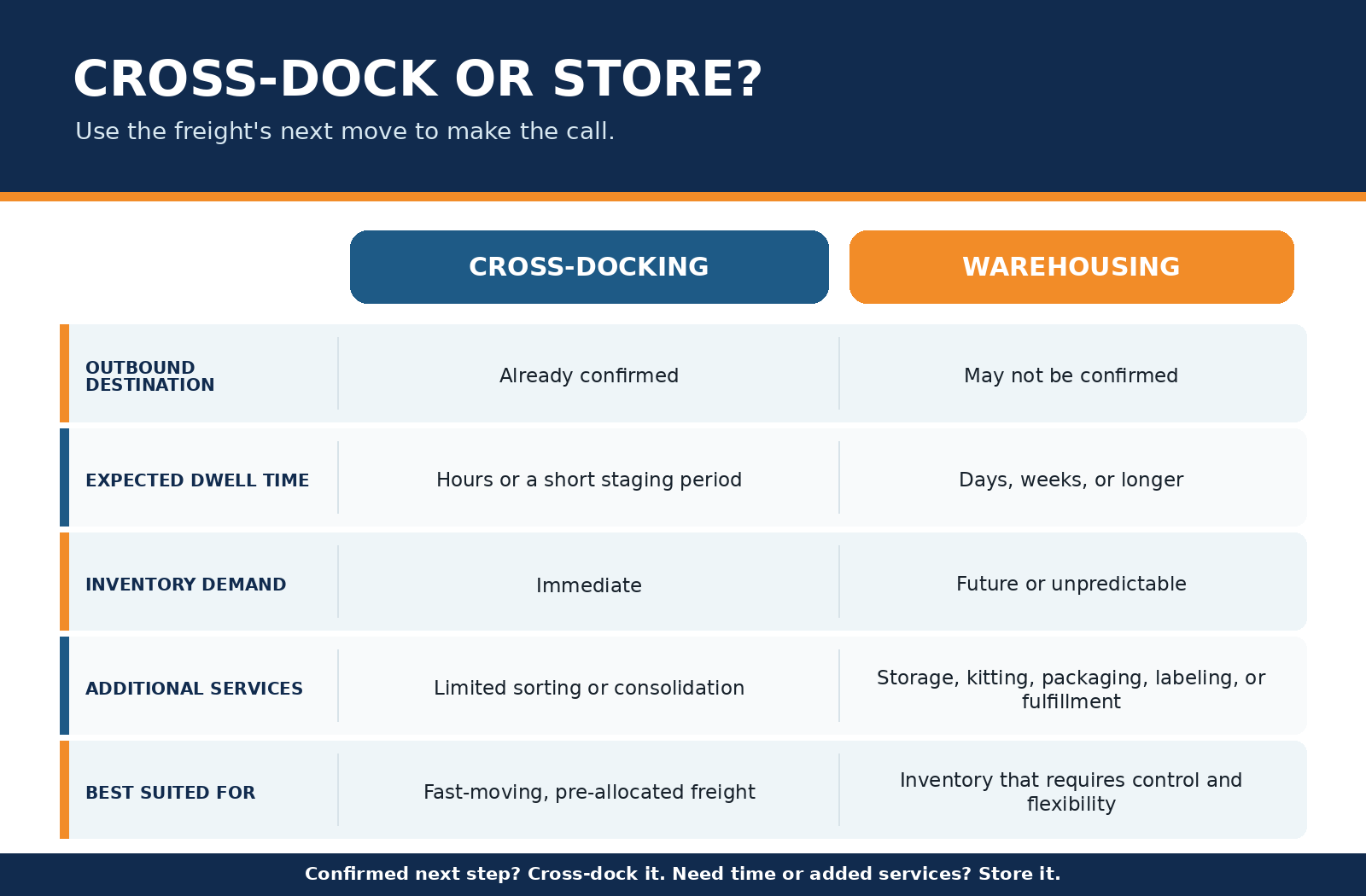
Cross-docking is usually appropriate for products with confirmed outbound plans. Warehousing is better for freight that must be held, tracked, processed, or released gradually.
What Is the Difference Between Cross-Docking and Warehousing?
Cross-docking moves products from an incoming truck to an outgoing truck with little or no storage between the two movements. Freight is received, sorted, and redirected toward its next destination.
Warehousing places the products into storage until they are needed. Inventory is recorded, assigned a location, and released according to customer orders or production schedules.
The difference is not simply how long the freight stays inside the building. It is whether the products already have a clear and immediate next step.
When Should Freight Be Cross-Docked?
Cross-docking works best when the freight arrives arrives with accurate documentation and a confirmed outbound plan.
For example, a manufacturer may receive a truckload containing products for four retail distribution centers. If the quantities and destinations are already known, the pallets can be separated and transferred to the appropriate outbound trailers rather than placed into warehouse storage.
Cross-docking may be the better option when:
- Customer orders have already been placed
- Outbound transportation is scheduled
- Products are labeled for their destinations
- The freight is moving through the facility rather than into inventory
- Multiple inbound shipments need to be consolidated
- A large shipment must be divided among several locations
The timing must be coordinated carefully. If the inbound truck arrives late or the outbound carrier misses its appointment, the operation needs enough staging space and a backup plan.
When Is Warehousing the Better Choice?
Freight should usually enter storage when its next destination or delivery date is uncertain.
Consider a manufacturer that receives three months of packaging materials at once to secure favorable supplier pricing. The plant does not have enough space to hold the entire order, and sending every pallet to production would create congestion. A warehouse can receive the materials, track the quantities, and release smaller loads as the plant uses them.
Warehousing may be more practical when:
- Customer demand changes from week to week
- Products must be held for future orders
- The shipment needs inspection or additional processing
- Inventory will be released in smaller quantities
- The final destination is not yet confirmed
- The receiving business lacks sufficient storage space
Storage creates more flexibility, but it also introduces additional inventory and handling requirements. The warehouse needs a clear method for recording what arrived, where it is located, and when it should leave.
What If Only Part of the Shipment Is Ready to Move?
The decision does not have to apply to the entire load.
A mixed shipment may contain fast-moving products for confirmed orders alongside inventory intended for future demand. In this case, the 3PL can cross-dock the allocated pallets and place the remaining freight into storage.
For example, an importer may receive a container with 20 pallets. Twelve are assigned to customers and can move directly toward outbound delivery. The other eight need labeling and will be held until orders are placed.
Separating the freight according to its actual next step can reduce unnecessary touches without forcing unready inventory into an outbound schedule.
How Do Timing and Transportation Affect the Decision?
Cross-docking depends heavily on transportation coordination. The facility must align receiving appointments, unloading, sorting, staging, and outbound pickups within a narrow timeframe.
Before choosing to cross-dock a shipment, confirm:
- When the inbound freight will arrive
- Whether the outbound carrier is scheduled
- How long sorting or consolidation will take
- Whether the shipment documentation is complete
- What happens if either truck is delayed
If those details remain uncertain, temporary storage may be safer than allowing freight to sit in a cross-dock staging area without a confirmed departure.
Does the Freight Need Work Before It Leaves?
Products that need extensive preparation are usually better suited for warehousing or a combined solution.
A shipment may require new labels, damaged pallet replacement, kitting, shrink-wrapping, repackaging, or order fulfillment before it can move. Trying to complete these tasks within a short cross-dock window may create errors or missed appointments.
The important question is whether the work can be completed accurately within the available time. If not, placing the products into tracked inventory gives the warehouse team more control over the process.
How Can a 3PL Help You Choose?
A 3PL can review the shipment’s timing, destinations, handling needs, and order status before the freight arrives. This makes it possible to create a plan for the entire load rather than deciding at the dock door.
Lake Park Logistics provides cross-docking, warehousing, inventory management, transloading, packaging, and transportation coordination from its Atlanta-area operations. Our team can help determine which products should keep moving and which need a controlled place to wait.
Contact Lake Park Logistics to discuss the next step for your inbound freight.
Frequently Asked Questions
1. Is cross-docking always less expensive than warehousing?
No. Cross-docking can reduce storage and handling when freight has an immediate destination. However, delays, incomplete documentation, sorting problems, or missed outbound appointments can create additional costs. The full shipment plan should be evaluated before making a decision.
2. How long can freight remain in a cross-dock facility?
Cross-docked freight typically remains at the facility for a short period, often only long enough to be sorted, consolidated, and transferred. If the freight needs to remain for an extended or uncertain period, warehousing may be more appropriate.
3. Can a shipment be partially cross-docked and partially stored?
Yes. A 3PL can separate products with confirmed outbound orders from inventory that must be held. This hybrid approach can help reduce unnecessary storage while maintaining control over products that are not ready to leave.
GMP Certified storage, long-term and short term storage solutions backed by cutting-edge technology for polished supply chain management.
the latest Logistics Trends
When Should a Manufacturer Use a 3PL During a Plant Expansion?

What Should You Look for in a HAZMAT Warehousing Partner?
HAZMAT Storage vs. Standard Warehousing: What’s the Difference?
Customer testimonials
Don't take our word for it - see what our happy customers have to say!
"They know their stuff! We needed a reliable warehousing partner for our growing business, and they absolutely delivered. The facility is spacious, our inventory is always accounted for, and their team actually cares about keeping everything running smoothly. Seriously, best decision we made!"
"Fast, efficient, and no headaches—that’s how drayage should be, and that’s exactly what we got. They handled everything coming out of the port like pros, kept us updated the whole time, and got our freight where it needed to be without any issues. Highly recommend!"
"The Lake Park Logistics team helped our supply chain immensely with their 3PL services. They gave us real-time tracking on our shipments, which really helped us identify where to improve and cut costs. It’s like having a whole logistics department without the hassle. Five stars all the way!"
Tailored Warehousing Solutions
Get a personalized consultation and quote today!